Why Building Muscle in Midlife is About Your Future — Not Just How You Look Today.
I’ve been working out for 36 years, so I thought I knew a thing or two about muscle.
Of course, I knew building muscle made us stronger. I knew having more muscle could change the way our body looked and felt. I knew strength training became increasingly important as we got older. And after years in the gym, teaching group fitness, owning a gym, and now creating my own strength programs, I certainly understand the whole “use it or lose it” thing.
But I recently listened to an episode of the Peptide PhDs Podcast that made me realize there was a whole other side of muscle I had never really thought about.
Muscle Communicates.
For most of my life, I thought of muscle primarily in terms of movement and strength. We build it so we can lift more. We need it to support and move our bodies. And yes, having some shape and definition doesn’t hurt either (I did just spend 12 weeks building some badass legs 😂. )
But muscle isn’t just there to move you or make you stronger, or give you quads that make people say things, like “Quadzilla”, or “Oh My Quad!” or even “Quaddamn”. I don’t make this stuff up. I hear all kinds of stuff.
Scientists now recognize skeletal muscle as an active signaling organ. When our muscles contract, they release chemical messengers called myokines that can communicate with other tissues and organs throughout the body.
And suddenly, “building muscle as we age” meant something a little different to me. This isn’t only about what my legs look like in a pair of shorts.
It’s about what those muscles are doing for me now — and what I’m going to need them to do for me 10, 20, and hopefully 30 years from now.
So, What Are Those Muscles Saying?
Your muscles aren’t sending one single message. Researchers are finding that the signals associated with active skeletal muscle may play roles throughout the body — which is one reason muscle is being studied as so much more than tissue that simply helps us move.
Think about what happens when you use your muscles. Your body has to manage energy and glucose. Your bones have to respond to the forces you’re placing on them. Your brain and nervous system have to support the work you’re doing. Your muscles aren’t operating by themselves; they’re part of a much bigger conversation happening throughout your body.
For years, I could look at a workout and think about what muscles I was training. Squats? Quads and glutes. Rows? Back. Curls? Biceps. But what if we stopped looking at strength training as something that only benefits the body part we’re working? When we use our muscles, we’re giving our entire body a reason to respond.
Your Muscles Are a Pretty Big Deal for Your Metabolism
One of the things from the podcast that really got my attention was just how much of a role our muscles play in handling glucose.
When we eat carbohydrates, much of that carbohydrate is broken down into glucose. That glucose enters the bloodstream, and our body has to do something with it. And guess who is one of the biggest players in that process? Our muscles.
Skeletal muscle is a major site for glucose disposal, particularly in response to insulin and after we eat. Muscle can take glucose out of the bloodstream and either use it for energy or store it as glycogen to use later. Exercise and muscle contractions also stimulate glucose uptake through mechanisms that don’t rely entirely on insulin.
Think of your muscles as having a pretty large fuel tank. When you put them to work, they need fuel. And one of the fuels they can use is glucose.
And considering how much we hear about blood sugar, insulin resistance, and metabolic health as we get older, that gave me another reason to look at muscle differently.
Building and using muscle isn’t just about changing our body composition. It’s part of taking care of our metabolic health too.
The Muscle You Build Now Is for the Woman You’ll Be Later
I think the part that we need to pay more attention to in midlife is that we’re not only building muscle for the body we have today. We’re building it for the body we want to live in later.
As we age, we become more vulnerable to losing muscle mass, strength and physical function. There’s even a name associated with age-related loss of muscle and function: sarcopenia. And while aging is going to happen whether we like it or not, becoming weak and incapable isn’t something we should simply accept as an inevitable part of getting older. Resistance training can improve strength and physical function even in older adults, including older women with sarcopenia.
Sure, I still want muscles that have hashtags associated with them (#quadzilla has 585k posts on IG 🤣). But I also want to be able to walk our property in Tennessee - I mean have you seen that incline? I want to be able to get myself off the floor. Carry my own groceries. Pick up something without worrying if I’m going to throw out my back. Travel. Keep doing the things I love — and maybe discover a whole bunch of new things I love — well into my 70s and 80s.
I don’t just want a longer life. I want a strong life. And the muscle I’m building now is an investment in that life.
It’s Not Too Late
I’ve said for years that it’s never too late to start strength training. You may or may not know that I coached people with Parkinson’s disease. Many of whom were older (both my parents). And you know how much their age mattered? ZILCH. They understood the importance of strengthening their muscle in order to have a better quality of life — and we had a lot of fun doing it. Many of them needed assistance from caregivers, but even the slightest improvement in strength or endurance could make life easier — not only for them, but for the people helping care for them.
I think about that a lot. None of us knows what the future holds, and there may come a time when we need help regardless of how well we take care of ourselves. But if we have an opportunity right now to build the strength that could help us remain capable and independent for as long as possible, why wouldn’t we?
And the research backs that up. One study I came across looked at adults ages 65-75 and another group who were over 85. Both groups completed the same 12-week resistance -training program three times a week.
And yes, the 85+ group built muscle too! Both groups increased their quadriceps muscle size and lean mass, got stronger and improved physical performance. And what I found especially interesting was that the researchers found no significant difference in how the two groups responded to training.
Think about that. Even in their late 80s and beyond, their bodies were still responding to strength training.
Building Muscle Doesn’t Have to Mean Going to a Gym
If the thought of strength training immediately makes you picture a gym full of heavy weights and sweaty men making grunting sounds, please don’t let that stop you before you even start. Resistance is resistance.
You can start with resistance bands. You can use dumbbells. You can use machines. You can use your own body weight for certain exercises. And yes, you can eventually lift some pretty heavy stuff if that’s where your journey takes you. The important part is that your muscles are being challenged.
I loved that Dr. Mindy Pelz talked about this in a recent episode of Live Like a Girl. She demonstrated simple exercises women can do at home with resistance bands, which I think is such an important reminder that strength training doesn’t have to look like my version of strength training.
I’ve been in gyms for 36 years. I’m comfortable around weights. I like lifting heavy things 😂We all start from the beginning. You just have to start where you are!
But You Have to Keep Challenging Them
Hear me loud and clear. Whatever type of resistance you choose, it needs to actually challenge your muscles. If you start with a resistance band and those last few reps are difficult, great. But eventually your body is going to adapt. That same band may become easier. That’s a good thing — it means you’re getting stronger.
Now you give your muscles a new reason to adapt. Maybe you use a stronger band. Maybe you add a few more reps. Maybe you pick up a heavier dumbbell. Maybe you add another set or progress to a more challenging version of the exercise.
That’s the basic idea behind progressive overload: as your body adapts, you gradually increase the challenge instead of doing the exact same thing forever. Progressive resistance training has been shown to improve strength in older adults, and elastic resistance itself can be an effective way to improve strength.
And no, that does not mean every workout needs to be harder than the last or that you need to keep pushing until your body is exhausted. Been there.
Challenge. Adapt. Progress
The Workout Is Only Part of the Equation
We can give our muscles a reason to get stronger, but then we have to give our bodies what they need to actually respond to that work.
That means protein and recovery. Protein provides the amino acids our bodies use to repair and build muscle tissue. And as we get older, paying attention to protein becomes even more important because our muscles don’t respond quite as strongly to smaller amounts of protein as they did when we were younger.
This is one reason I’ve become much more intentional about getting enough protein throughout my day — and especially making sure I’m getting a good amount at each meal.
Then there’s the part I spent A LOT of years overlooking: Recovery.
My mentality used to be train more. Lift more. Push harder. I didn’t get sore, so I never thought about resting my muscles. Not sore? Keep going! And on top of that, I couldn’t sleep. What I didn’t fully appreciate back then was that the workout is only the stimulus. It’s during recovery — supported by things like protein, adequate nutrition and sleep — that our muscles have the opportunity to repair and adapt to the work we’ve asked them to do. So, day after day, year after year, I was asking more and more from my body without giving nearly as much attention to recovery. Eventually, it caught up with me.
I’ve learned my lesson and I don’t think like that anymore. Strength training creates the stimulus. But our muscles need nutrition, sleep and recovery time to repair and adapt to that stimulus. So, the days we recover aren’t days when “nothing” is happening.
What Are You Building For?
I started this blog post talking about everything I thought I already knew about muscle after 36 years of working out. And yes, I still want strong legs. I still like seeing muscle definition. And I will absolutely continue to appreciate a good “Quadzilla” comment. 😂But I’m thinking about muscle differently now.
I’m thinking about those muscles communicating with the rest of my body. I’m thinking about metabolic health. I’m thinking about the property in Tennessee with that ridiculous incline. But mostly, I’m thinking about the woman I’m going to be 10, 20, and hopefully 30 years from now. Every time I strength train, eat enough protein, or choose recovery instead of pushing harder, I’m doing something for her.
And maybe that’s the question worth asking yourself too: What do you want your body to still be able to do 20 years from now? What are you building for? We’re not just building muscle for the mirror. We’re building options for the women we’re becoming.
Ready to Start Building Your Strength?
You don’t need a gym. You don’t need a complicated workout plan. And you certainly don’t need to wait until you feel “ready.”
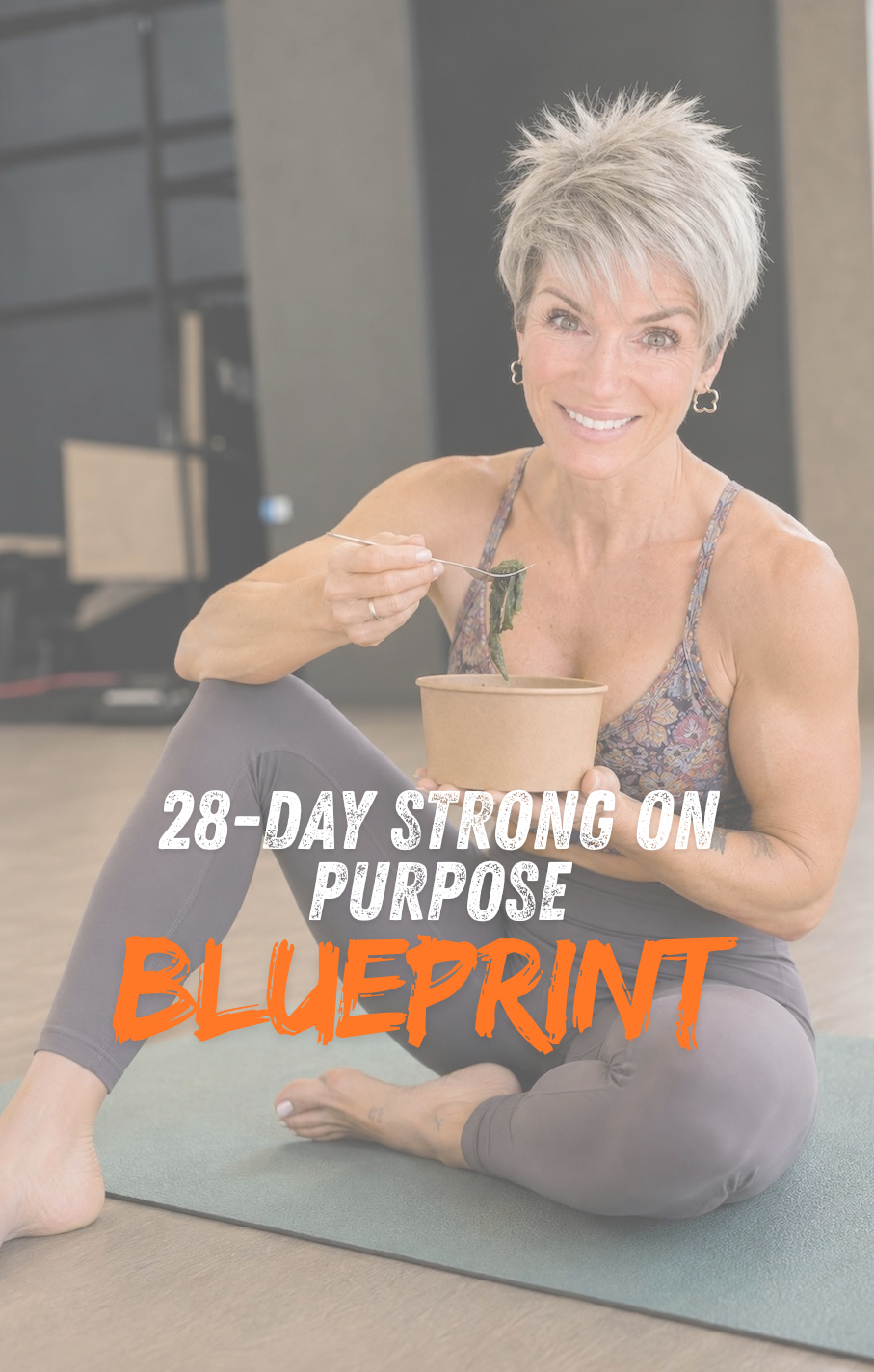
My 28-Day Strong on Purpose Blueprint gives you a simple place to start with three strength workouts each week using resistance bands and your own body weight — all designed to be done wherever you are.
Because knowing why muscle matters is important. But eventually, we have to use it!