What a 48-Hour Fast Taught Me About…Me!
I just completed a 48-hour fast.
To some that might seem a little extreme, but you have to understand the reason behind it before you go there.
Since becoming a fasting coach, I’ve been working my way through different fasting protocols so I can experience them for myself.
I can read about fasting. I can study the science. I can take courses and learn the protocols, but if I’m going to coach women through this someday, I also want to understand what it actually feels like to do it.
So, this time, I wanted to see what 48 hours would teach me.
Why 48 Hours?
Part of this was simply curiosity. I wanted to pay attention to what happened with my hunger, energy, mental clarity, and relationship with food as the hours went by.
Would I suddenly get that amazing mental clarity people talk about?
Would my energy increase?
Would I spend two days dreaming about food?
And since I’m experiencing these fasts for myself, this was another opportunity to learn what my body does rather than assuming everyone experiences fasting the same way.
Turns out, that may have been one of my biggest takeaways.
Did I Feel Amazing?
Here’s the part that probably isn’t going to make a very exciting fasting commercial:
I didn’t experience some dramatic surge of energy during the fasting period, like many people do, but as I write this almost 30 hours since completing the fast, I feel energetic. I intentionally chose not to workout during the 48 hours and gave my body permission to rest. Today I feel well-recovered - I guess the true test will be when I go workout this afternoon.
My brain didn’t suddenly become sharper than it normally is, and that’s one of the biggest things I was hoping to experience. That doesn’t mean fasting can’t help with brain fog. It simply reminded me that every body is different, and we may not all experience the same benefits — or experience them at the same time.
We hear so much about what we’re supposed to feel when we’re doing something for our health that sometimes we start looking for an experience that may or may not happen.
My experience was simply my experience, and that’s useful information too.
What I Did Notice
I did drop a few pounds, but what surprised me most wasn’t necessarily physical. It was how much easier things felt when the decision had already been made.
I wasn’t deciding what to eat.
I wasn’t wondering whether I was hungry enough to eat.
I wasn’t walking into the kitchen and negotiating with myself.
The boundary was clear: I’m fasting.
There was something incredibly freeing about that. Fewer decisions. Clear boundaries. And maybe most importantly, proving to myself that I could do something I had decided to do.
Hunger surprisingly showed up pretty early, but it also disappeared. Instead of sitting there fixating on what I was missing out on, I got up and moved. Gardening gave me something I enjoyed doing, and helping move brick pavers definitely kept my mind occupied.
I also noticed a slight headache later in the fast, which is probably because I hadn’t properly hydrated. And I quickly realized that moving those pavers was probably NOT the thing to do while fasting!
Perhaps the biggest thing I noticed was this: I am so much more focused and accountable when I have a plan than I tend to be when I don’t.
That lesson extends far beyond fasting.
And Then Came the Food…
One thing I’m learning is that completing the fast is only part of the experiment. How I come out of it matters too.
Rather than finishing 48 hours and immediately celebrating with everything I hadn’t eaten for two days (hello gummy worms), I intentionally reintroduced food.
And then the next morning, I built my first full meal around protein, fiber, healthy fats, fermented foods, and whole-food carbohydrates. And yes…food tasted REALLY good!
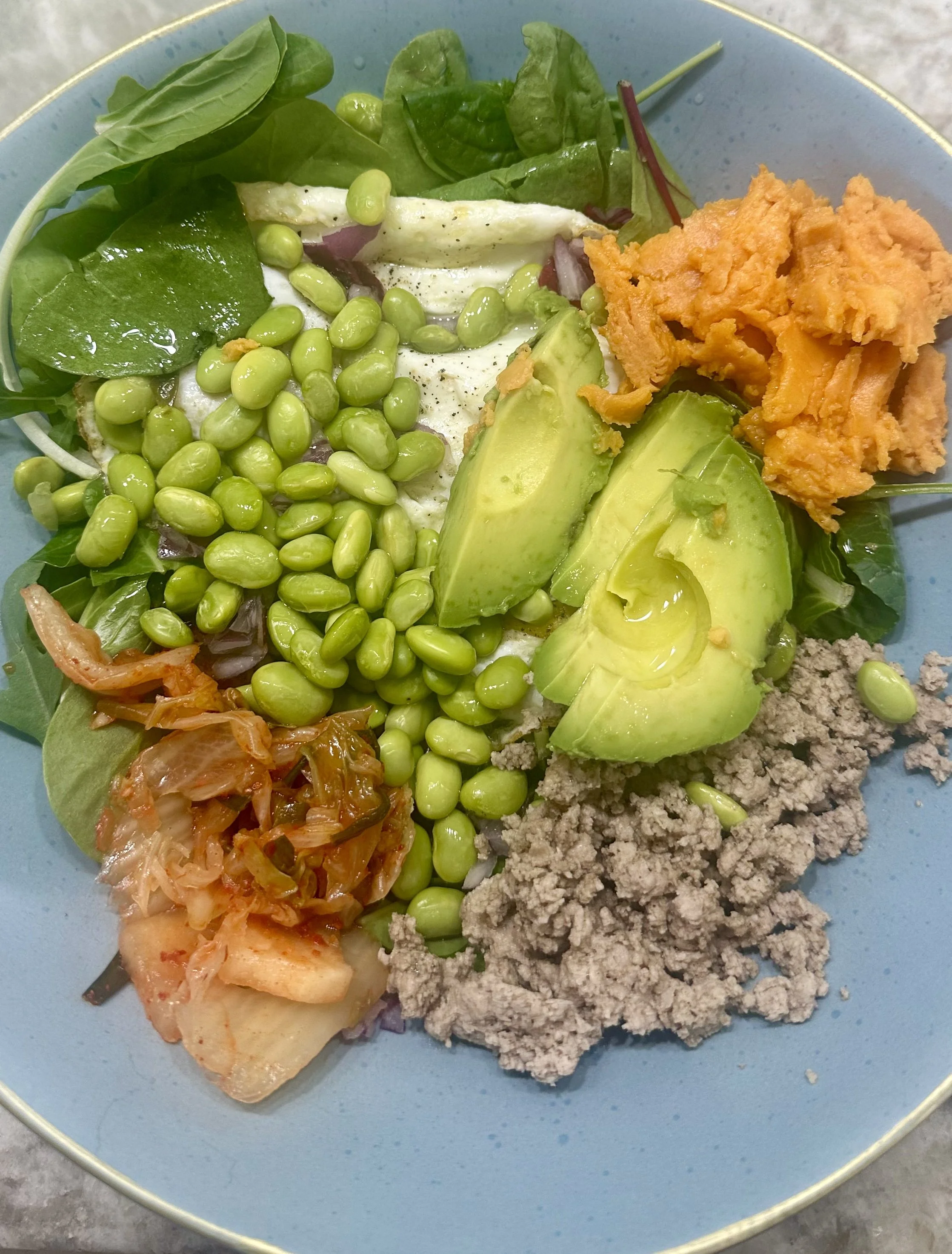
Protein Forward!
Ground turkey, edamame, kimchi, eggs, spinach, sweet potato, avocado
But there was something different about sitting down to that meal with intention instead of treating the end of a fast as permission to go crazy.
I knew what I wanted on my plate and why it was there.
Especially Here in the South…
Food isn’t just fuel.
It’s birthdays and holidays. It’s Sunday dinners and backyard cookouts. It’s bringing somebody food when they’re having a hard time. It’s gathering around a table with people you love.
It’s how we celebrate, comfort, gather, and connect.
I grew up with a mom who baked, owned a bakery, and a small catering business. I worked for her when I was 15. There was always something being cooked, baked, or shared. Food was simply part of life, and I love that.
I don’t want wellness to mean losing that part of my life.
But fasting has made me more aware of how often we eat because food is there, because it’s time, because we’re celebrating, because we’re bored, or because eating is simply what we’ve always done.
There’s a difference between enjoying food intentionally and eating automatically.
I’m learning that difference.
My Biggest Takeaway
I went into this wondering what a 48-hour fast might do for my body.
I came out of it thinking just as much about what it taught me about my mind.
I like having a plan. I’m more accountable when I know what I’m doing and why I’m doing it. Clear boundaries actually make things easier for me—not harder.
And sometimes the win isn’t a number on the scale, a ketone reading, or some dramatic burst of energy.
Sometimes it’s simply realizing I said I was going to do something, and I did it.
So…Would I Do It Again?
Yes. Not because I think everyone needs to fast for 48 hours. And not because I had some magical experience during those two days.
I’d do it again because I’m learning. I’m learning about fasting. I’m learning about my body. I’m learning about my relationship with food. And I’m learning which tools I may eventually use when I’m coaching other women through midlife.
I’m going to keep experimenting, learning, and paying attention to how different fasting strategies feel in my own body.
Not because every woman should fast exactly the way I do. Quite the opposite.
The more I learn, the more I realize that there isn’t one perfect fasting schedule—or one perfect way to navigate midlife.
The goal isn’t to find the perfect plan. It’s to understand your body well enough to find what works for you.
Until next time,
Melissa
Curious About What Works for Your Body?
You don’t have to start with a 48-hour fast. In fact, I have something much simpler coming soon.
The 7-Day Shift is for women in midlife who are tired of feeling frustrated with their bodies and want to finally understand why things are happening the way they are, and what they can do about it. I’ll be sharing more about that very soon!